

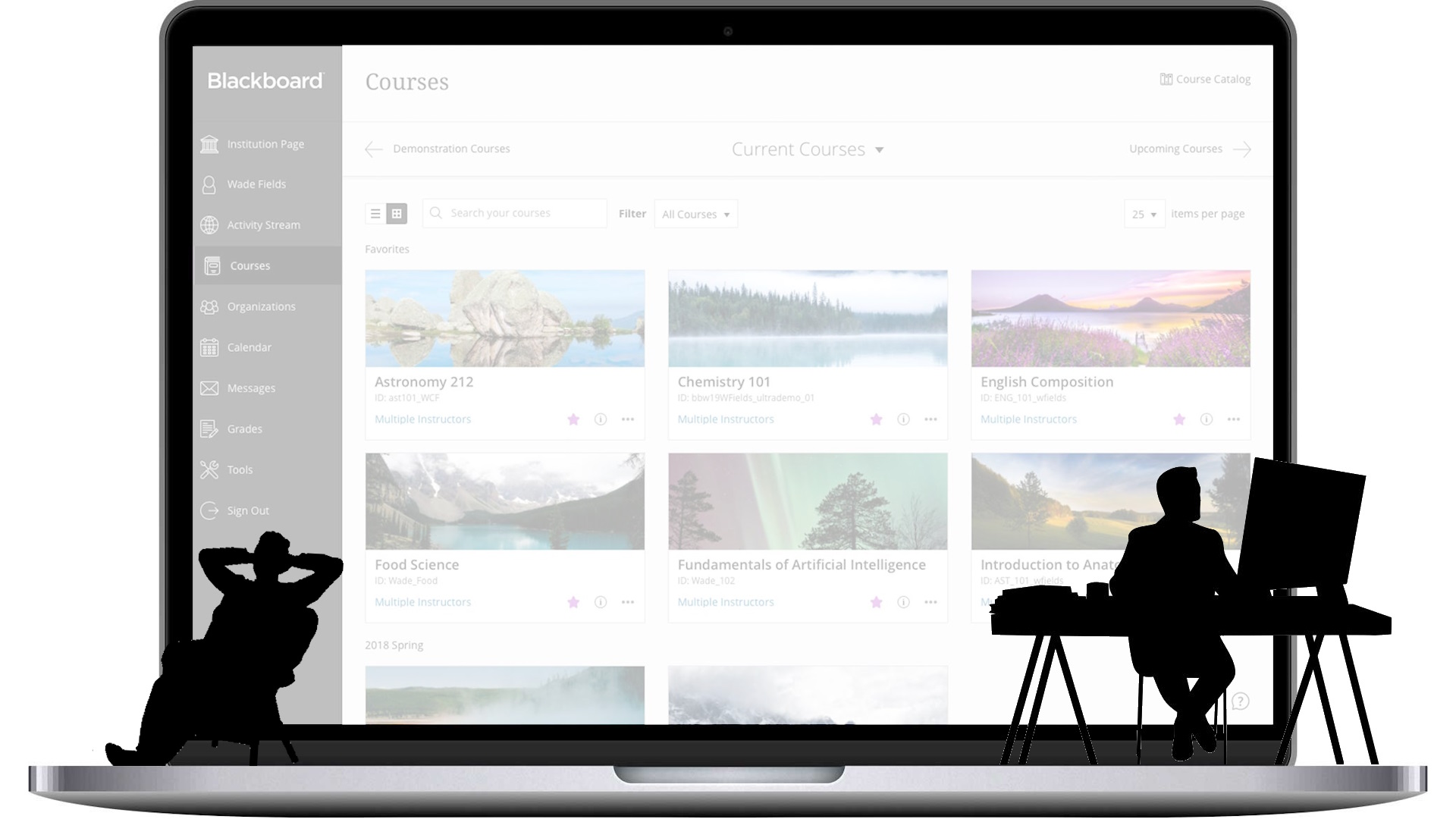
Among other modalities, I teach asynchronous classes. I like them and the students like them. Asynchronous is what your typical student thinks of as “online”. They do the work when and where they want. They log in to the digital classroom, which in industry speak is the learning management system or LMS. There are a few big LMS’s out there like Blackboard, Moodle and Canvas. They go to their class and see what is assigned. Often work is assigned to an online learning platform. Online learning platforms fulfill the role of old school textbooks. Now they are basically interactive websites. If you are unfamiliar with modern learning tools, you can think of the LMS as the operating system like Windows, and the online learning platform is like a textbook app that runs on windows. Teachers love these digital textbook style online learning platforms because they include lots of autograding assignment options. Yes, they have more traditional assignments that have to be manually graded, but like I said, these things are the modern equivalent of textbooks. The textbook publishers know many teachers will only choose digital textbooks that have autograde assignments, so they include both types of assignments (auto and manual grade) and the teacher gets to choose how many of each based upon their preferences. I recently had a chance to work with two classes with instructors who were on opposite ends of the auto-grading spectrum. As I was working in the classes I was struck at how much it was a great commentary on how your work ethic is a decision that should be carefully considered.
First a little bit about teaching in the public sector. These observations are from the community college level but they can be applied to the other levels. As many critics of our educational structure here in America will attest, teaching in the public sector is a minimum spec type of job. It is foundationally a government service after all. As an example, from a credentialing perspective, an instructor has to meet a minimum education requirement to teach specific classes. It doesn’t matter if they are knowledgeable or enthusiastic about the subject. It just matters that they have the degree.
Additionally, there are identified learning outcomes that have to be achieved. These outcomes can be gamed meaning all that is required is that you can point to an assignment or assignments aligned to the learning outcome that show the majority of students passing. Of course, like most government jobs, everyone gets paid the same. It doesn’t matter if you do a ton of work or if you do the minimum. It doesn’t really matter if your uninteresting or really creative and engaging.
In addition to all of this, the shortage of credentialed instructors means that it’s hard for schools to get rid of lazy or uninspiring teachers. What the private sector would refer to as a C level or low level performer. As long as you meet the minimum spec for the class, you keep your job. This means that the only reason to do the ton of work required for a quality job is because you want to.
For Asynchronous online classes, the baseline for instructors performance is on demand support and to be a formerly qualified subject matter expert or SME’s. On-demand is a misnomer as most people think that entails 24/7 and instant response times. The reality is that usually instructors have two or three days to respond to a student email. The teaching, as it were, can all be done before the class starts in the creation of the course shell. I can say from experience that often we become more of a technical support resource than a teaching resource. Students will reach out with a question on an assignment which is more about interfacing with the software than it is about the concepts. On the rare occasion that the student does have a question on the course content, our value is being able to explain the concepts more fully.
As I said, this is the baseline for asynchronous online courses. We aren’t completely limited to that. Instructors can take a more active and engaged role in the course or the more laid back support only approach.
My first experience with an extreme instructor was when I shared a course with one who did only the bare minimum. They went through the online system, plugged in the links to the textbook exercises that were auto graded, and that was it. There were announcements but they were single sentence reminders. Things like: “This week Chapter 8 is due”. Nothing else. In effect the instructor set up an auto graded online class that needed close to zero input by them. Their total time required past setup was most likely measured in minutes per week. It was far from a rich online learning experience but it met the minimum spec. The instructor was very proud of the fact that everything took care of itself automatically and required practically no work to manage.
The second experience happened when I was adjuncting for a sister community college. I was given a copy of a course shell that might as well have been the most intricate and engaged asynchronous online course in history. The instructor had done everything that you could possibly ask for. There were personalized assignments and Introductory videos from the instructor for each section. In addition to the textbook information the instructor had video lectures where she had narrated the powerpoints. She provided lots of extra information on each chapter, admittedly they are something that 99% of students won’t read but they were there for the 1% who would. On the personalized assignments she had multiple due dates for drafts so she could carefully provide feedback as the students developed their submissions. From my rough estimate, she spent dozens if not hundreds of hours carefully sculpting content for the course that would enhance the information provided by the online textbook. Additionally she spent 10 or so hours each week working on the course throughout the semester. Compare this to the first instructor who probably spent three hours setting up the course and maybe as much throughout the whole semester responding to students and doing the paperwork.
Here is the most interesting part. It was the same course. Literally the exact same course that’s outlined by the state. It was just handled differently by two different college instructors at two different institutions. Both sections of the course met the spec. One instructor did the absolute minimum. The other instructor made the decision to take on a tremendous workload to provide the richest learning experience possible.
The differences between the two courses were so stark , it was the inspiration for this article and the central question behind it: If you can get away with doing minimal work, should you do extra if there is no professional benefit to it? To be practical, people don’t do lots of work unless there is some benefit, at least to themselves, so that leads to the second question: What’s the benefit to doing a good job? That question is a bit easier to answer. But before I answer the question of what is the real benefit to the hard working instructor, let me touch on my other comment. That’s where I make the case there is no benefit to going over and above in a minimum spec job.
In truth there is one, albeit minor, benefit to working more than you technically need to. That’s your reputation with your colleagues. Everyone knows who’s super lazy and does the minimum amount of work. This may have a minor impact on your career progression. This is assuming you want to progress in your career. I know many, many individuals, including the majority of teachers, who have zero interest in climbing the ladder. It’s an industry of diminishing returns. Immediately the first step up the ladder loses the benefit of summer breaks. That’s huge. The second and third rungs don’t bring in much more income but do bring in a ton of stress. We can’t forget that if your an instructor in a field where the private sector pays substantially more than the education sector, your job is mostly secure simply because it’s hard to replace someone with your credential. It’s the same thing with career progression. It’s all because the pool is so small to recruit from. So if you wanted to give up summers for that little bit of extra pay, then you can do it fairly easily, even if you have to jump institutions. This is true no matter how lazy of an instructor you are or if you are considered a C or D level employee by management.
The only reason why I can think to go over and above in the minimum spec job is because you enjoy it and you have the bandwidth to do it. Ultimately it’s for self satisfaction and to reinforce your identity. I’m sure the super teacher who went nuts with her online asynchronous course got a tremendous amount of satisfaction out of the fact that she created the absolute model online course. As instructors we get regular professional development and part of that is to be trained on best practices for these types of courses. I have to admit I think every single thing that’s ever been suggested in every training was there in the class. It was pristine. I’m also sure she takes pride in being a great teacher who believes she has a big impact on students, even in the asynchronous classes where there is little direct student interactions.
This is how I feel about my blog and podcast. I know I’m ending it very soon, but for ten years it’s been a labor of love. Every now and again I’d get someone with whom an article had enough of an impact where they would reach out to me. That’s the blog equivalent of having a positive effect on a student. Those types of interactions motivated me to continue, but it didn’t happen nearly as much as it happens in the classroom. In the end I got burnt out with the blog and podcast and that does also happen to some teachers. After all, if you put in 10 hours a week, and your colleague puts in 10 minutes a week on the same class, and nobody cares about the difference in quality, not even the majority of students, that will eventually have an effect on you. The only way to stave that off is to surround yourself with colleagues who believe and act the way you do. Being part of a tribe that believes in excellence is a way to continue in perpetuity. Like my blog, all that extra work will have a positive impact on a student every now and again, just not all the students.
Speaking of students, going back to the two classes. There may be a question or a thought about how the students who had the minimum spec instructor got shafted with a poorer learning experience. That’s not necessarily true, at least not for the 99% of students who just want to get through the course. It’s my experience that the vast majority of students only want to meet the spec as well. They aren’t necessarily in it to learn. They are in it for the grade and the degree and they want to do the minimum learning required to get there. Sadly this means the minimum spec instructor is actually serving the students wants, but maybe not their needs, better than the instructor who went above and beyond. But as I said, there is always the outlier who wants to learn and appreciates all that extra work you put in.
So it’s up to you, it’s all about what you like. If you enjoy putting in the extra effort and striving for excellence, and the level of commitment needed doesn’t negatively impact other parts of your life, then do it. It doesn’t hurt anything and someone may benefit from it. If you don’t enjoy extra work, and you can get away with doing practically nothing and still collect your paycheck without negative consequences, you will most likely continue on doing just that. I will end this by saying that the bare minimum approach isn’t nearly as interesting to me so I don’t get why people would stay in a job like that. It seems to me that if you aren’t into your work enough where you are motivated to do a great job, then maybe it’s time to go find another job that is exciting to you. This may require some retraining. If you do go back to school to learn more about something that really excites you, then I have one bit of advice. Keep your eye out for that teacher who goes over and above. Because, now your that rare student who can benefit from all their extra work and that’ll be a win / win for both of you!
Like what you read?
I spend hundreds of hours working on these articles every year with no compensation other than support I get through donations. You can support with a tip and by subscribing to the podcast (and writing a review on iTunes would be really appreciated as well!)
One time tips:
https://venmo.com/pelusopresents
On Going
https://www.patreon.com/PelusoPresents
In addition to subscribing here on Medium.com, you can also find more writings by Mike Peluso at:
The Blog:
With hundreds of archived articles, Peluso Presents is your source for commentary, ideas and insight in navigating the collision points between work and life.
The Podcast:
http://pelusopresents.libsyn.com/
For those who are on the go, every episode of the Peluso Presents podcast includes a reading of a highlighted post as well as other great entertaining information. Available wherever you get your podcast fix from! Subscribe on iTunes!
ITUNES: https://itunes.apple.com/us/podcast/the-peluso-presents-podcast/id1143822193?mt=2&ls=1
GOOGLE PLAY: https://play.google.com/music/podcasts/portal/
RSS FEED: http://pelusopresents.libsyn.com/rss
Twitter: https://twitter.com/PelusoPresents
Get reminders of articles, Tweet AT me, and occasionally see some other great tweets by Mike!
Email: Peluso AT Outlook.com
Your feedback and suggestions / requests are super valuable! Email is for those who still like to communicate old school!


